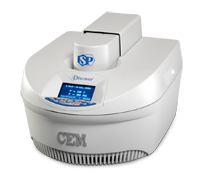
Synthesis and biological activities of new bis-indole derivatives via CEM Discover microwave irradiation
21. Sep. 2017 |
Ulf Sengutta
Ahmed H. Halawa/ Ahmed H. Bedair / Ahmed M. El-Agrody/ Essam M. Eliwa/ Marcel Frese/ Norbert Sewald
Abstract
Three new series of bis-indole derivatives were synthesized based on p-phenylenediamine (2–4, 5 and 6) and 4,4′-ethylenedianiline moieties (7–9) using facile and efficient condensation of three positional isomeric indole-carboxaldehyde derivatives (1a–c) with bifunctional amines upon microwave irradiation. The symmetric dimeric indole derivatives 2–4 as well as non-symmetric analogues 5 and 6 were obtained by in situ condensation of the respective positional 3-, 2- and 5-isomeric indole-carboxaldehydes with p-phenylenediamine, while compounds 7–9 resulted from respective condensation based on 4,4′-ethylenedianiline. Structures of the obtained compounds were deduced by advanced spectroscopic methods (1H NMR, 13C NMR and MS). In agar diffusion assay, derivative 6 showed moderate antibacterial activity against various Gram positive and negative bacteria, while derivative 7 displayed moderate activity against several Gram positive bacteria. However, in Resazurin assay employing the human cervix carcinoma cell line (KB-3-1), derivatives 2–9 turned out to be inactive.
#Discover#Mikrowelle#Mikrowellen Synthese#Mikrowellensynthese#Mikrowellensynthese Vorteile#Organische Chemie#organische Synthese#Synthese Chemie